PND AI Photo Enhancer HD
- 4.8
- Rating
- 100.00K
- Installs
- Free
- Price

 Analysis by App-foxy
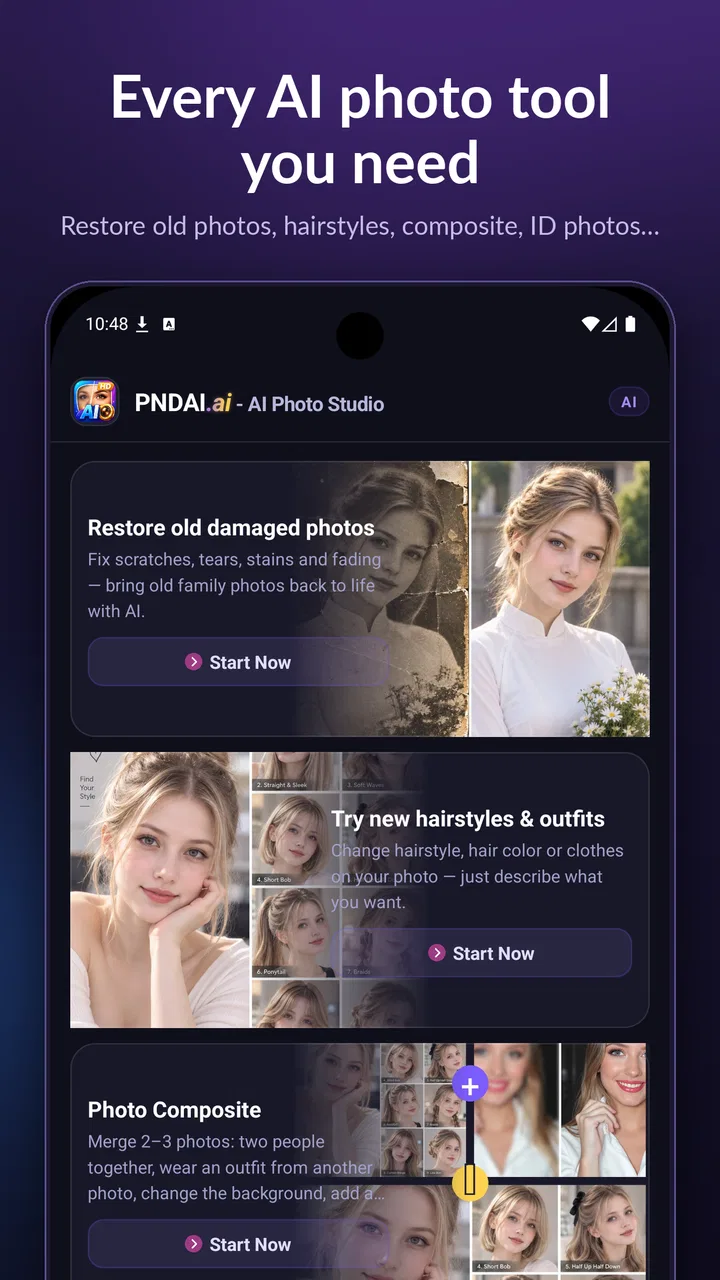
I approached PND AI Photo Enhancer HD as a practical beauty and photo-editing tool rather than a full replacement for a professional editor. Its focus is clear: improve soft images, bring older pictures back into usable shape, remove unwanted objects, and prepare ID-style photos with AI assistance. After using it for those kinds of jobs, I found it most appealing when I wanted a quick correction without learning a complicated editing workflow.
The app is made by PND AI 360 and is available as a free download for Android users. It has an average rating of 4.8 from around 2.8 thousand ratings, with more than 100 thousand installs. Those figures suggest that it has found an audience among people who want straightforward image repair, but they do not tell the whole story. The important question is whether its AI approach suits the kind of images you actually need to fix.
How the app feels during everyday editing
The first thing I noticed is that this is not an app I would open for elaborate layer work, detailed color grading, or carefully controlled retouching. Its value is in reducing the number of decisions between choosing a picture and getting a more presentable result. That makes it useful for casual portraits, family archives, profile images, and quick document-photo preparation.
You May Also Like

 Blood Strike: 2.5 Anniversary
Blood Strike’s Loadouts Turn Every Drop Into a Tactical Gamble
A close look at Blood Strike’s custom loadouts: how fast access to signature weapons reshapes its battle royale rhythm, rewards preparation, and narrows the gap between fights.

 Pandora - Music & Podcasts
Pandora’s Music Is Easy to Start, but Harder to Recover
Pandora’s strength is its low-effort path from a seed to a station. Its weak spot is how much confidence it asks you to place in connection, setup, and quiet recovery.

 8 Ball Pool
 Is Built on Rivalries, Rematches, and Routine
A close look at the rivalries, rematches, shared routines, and unanswered safety questions that turn a quick pool match into a persistent mobile community.

 Samsung Music
’s Quiet Strength Is Playing What You Already Own
Its reach comes less from spectacle than from dependable access to a personal library. That simplicity is both the app’s strongest retention engine and its ceiling.

 AccuWeather: Weather Radar
AccuWeather Review: A Quick, Clear Forecast for Everyday Decisions
For everyday plans, the best forecast is the one you can understand quickly. AccuWeather makes rain timing, radar, and local conditions easy to act on, with a few trade-offs.

 Hill Climb Racing
Why Hill Climb Racing Still Turns Crashes Into One More Run
A tiny car, a bumpy hill and one more upgrade: Hill Climb Racing keeps resurfacing because its simple chaos makes every near-miss feel personal.
More From Our News Desk



For a slightly blurry face, an old scanned photograph, or a picture with a distracting object in the background, the appeal is obvious. Instead of searching through many manual tools, I can start with the task that matches the problem. That direct approach is especially helpful on a phone, where precision editing can feel cramped and slow.
The best results come when the original image contains enough visual information to work with. AI enhancement can make a low-quality image look cleaner and more defined, but it cannot reliably recover details that were never captured. A small, heavily compressed face may become more attractive at a glance while still showing artificial texture when viewed closely. I would therefore treat the output as a polished interpretation, not a guaranteed restoration of the exact original.
Speed expectations before you begin
AI photo work naturally feels different from ordinary cropping or brightness adjustment. The app has to process the selected image, so the wait can depend on the picture and the phone. I would not judge it by the instant response of a basic gallery editor. For a single casual edit, the workflow feels suited to a short pause; for a large batch, patience becomes more important.
A useful habit is to decide the purpose of the image before processing it. If I only need a picture for a messaging profile, I do not need to chase perfect detail. If I am repairing a family photograph, I inspect the result more carefully and keep the original untouched. This prevents me from repeatedly running the same image through an enhancement tool just because the first result was not flawless.
The free entry point also makes experimentation easy. You can try the basic workflow before deciding whether the app deserves regular space on your phone. In-app purchases range from $1.99 to $24.99 per item, so I would look at the available purchase options carefully before treating it as a long-term editing solution. The free download is convenient, but “free” does not mean every possible workflow will necessarily remain free.
What happens during heavier use
The app becomes more demanding when the job is more ambitious: restoring several old photos, testing multiple versions of one portrait, or repeatedly removing objects from crowded scenes. AI processing can also expose weaknesses in the source image. A clean, well-lit portrait is an easier candidate than a dark photograph with overlapping people, hair, patterned clothing, and a complicated background.
For that reason, I would use it in small groups rather than selecting an entire archive at once. Process one image, inspect it at a useful zoom, and then decide whether the same approach makes sense for the next one. This is not just a speed tip. It helps avoid creating a collection of similar-looking edits when some originals need a different treatment.
Object removal deserves particular care. It can work well for a simple distraction against a relatively plain background, such as a bin at the edge of a walkway or a small mark on a wall. It is less predictable when the removed object interrupts important lines, text, hands, hair, or repeating patterns. I would always check the area around the edit, not just the object that disappeared. A clean-looking center can hide a warped background nearby.
The same caution applies to old-photo restoration. Scratches, faded contrast, and softness may improve together, but a face can also gain details that look plausible rather than historically accurate. For treasured family images, I would save the original scan and compare the enhanced version beside it. The app is useful for making an image easier to view and share; it should not be the only copy of an important memory.
Stability and recovering from an imperfect result
My view of reliability here is less about expecting every image to be perfect and more about having a sensible recovery routine. AI editing is inherently variable because the source material varies. A result that looks excellent on one portrait may be too smooth on another, while an object-removal attempt may leave an obvious patch in a busy scene.
When an edit misses the mark, I would not keep applying more corrections to the already processed file. I would return to the original and try a narrower task. For example, if a full enhancement makes skin look unnatural, the better choice may be to use the original for the final picture and reserve the restored version for a smaller crop. If object removal creates a strange edge, a conventional crop may solve the problem more honestly.
This workflow also answers an important practical concern: should you trust the app with irreplaceable images? I would use it as a working copy tool, not as the sole storage place for originals. Keep the untouched photo in your normal gallery or backup system, then treat each generated result as an experiment. That approach protects you from both an unsatisfying edit and the general risk of losing the starting image during a busy session.
For everyday sharing, a slightly imperfect result may be completely acceptable. A repaired image viewed on a phone screen can look convincing even when a close inspection reveals invented texture. For printing, official documents, or images where identity and accuracy matter, I would apply a stricter standard. AI enhancement can improve presentation, but it should not alter the person’s recognizable features or create misleading detail.
Device limits and practical expectations
The app supports Android 7.0 and later, which covers a broad range of devices. That compatibility is helpful if you are using an older phone for family photos or document tasks, but operating-system support does not guarantee identical performance across every handset. Processing comfort can still vary with available storage, memory, processor capability, and the size of the selected image.
On a modest device, I would avoid editing while many other demanding apps are open. Closing unnecessary background activity can make the overall session feel less crowded, even though it cannot change the complexity of the AI task itself. I would also avoid starting with the largest possible image when a smaller copy is enough for the intended use. A profile picture and a print-ready archive scan do not need the same workflow.
Storage is another consideration that is easy to overlook. Keeping the original, several enhanced attempts, and exported copies can quickly make a photo folder harder to manage. I prefer a simple naming habit: retain the original, mark the chosen result clearly, and delete failed experiments after comparing them. This matters particularly when restoring many old pictures, because duplicated files can become more burdensome than the editing itself.
Users who need advanced control may feel constrained. Traditional editors are better when you want a precise brush, adjustable masks, selective sharpening, curves, layers, or a reversible sequence of changes. PND AI Photo is more attractive when the goal is “make this usable” rather than “let me control every pixel.” That is an important trade-off, not a flaw for everyone.
Real situations where it earns a place
Imagine finding a faded family portrait before a birthday gathering. The photo is recognizable but soft, and a person standing near the edge distracts from the group. I would first preserve the scan, then test enhancement on a copy, inspect the faces, and only afterward try removing the distraction. If the removal damages the background, I would keep the enhanced image and crop the edge instead. This two-stage approach is safer than demanding that one AI pass solve every problem.
Another useful situation is updating an ID-style image. The dedicated ID-photo purpose can save time when you need a cleaner, more formal result than a casual selfie. Still, I would check the requirements of the organization receiving the photo. An editing app can help prepare the image, but it does not automatically guarantee that the final picture meets every official rule about framing, background, lighting, or acceptable appearance.
It can also help with a quick social profile refresh. A portrait that is a little soft after being cropped may benefit from enhancement, while a small background distraction can sometimes be removed. Here, the app’s convenience matters more than archival accuracy. I would keep the edit restrained, because an overly processed face is often more noticeable in a small profile image than a little natural softness.
For product sellers, the object-removal function may be useful for cleaning a simple background around an item. I would be more cautious with valuable listings or anything where shape and condition must be represented exactly. Removing a cable, stain, or unrelated object can improve presentation, but altering a scratch or edge could give a buyer the wrong impression. The right workflow is to remove distractions without hiding meaningful information.
Where usual alternatives are better
Compared with a standard phone gallery editor, this app offers a more focused route to AI-style repair and enhancement. A gallery editor is usually better for quick exposure, rotation, cropping, and color changes because those actions are predictable and immediate. I would choose the gallery first for a picture that only needs straightening or brighter shadows.
Compared with a full photo editor, PND AI Photo is easier to approach but less controllable. A professional-style app is the stronger choice when I need exact selections, consistent output across a large set, or careful retouching that can be adjusted step by step. Those tools demand more time, but they also make it easier to understand what changed.
Compared with a dedicated document or ID-photo service, this app is convenient for personal preparation but should not be treated as an authority on official acceptance. Its value is bringing the image into a cleaner starting state. If the photo is for a passport, license, visa, or another formal process, I would verify the destination’s requirements separately and inspect the final crop at full size.
Who should use it, and who should skip it
I would recommend it to someone who regularly receives blurry pictures, wants to make old family images more shareable, or needs a quick way to remove minor distractions. It is also a reasonable option for people who find traditional editing interfaces intimidating. The free download makes it easy to test the workflow without committing immediately to a paid tool.
I would be less enthusiastic for photographers who need color accuracy, controlled sharpening, non-destructive layers, or repeatable professional output. I would also skip it as a primary solution for large restoration projects unless I had already tested representative images. A tool that works beautifully on one clean portrait may struggle with a damaged group photo, a reflective surface, or a background full of fine lines.
Privacy-conscious users should make their own comfort decision before processing personal portraits or identity-related images. Since this is an AI photo app, I would avoid uploading anything sensitive unless I understood how I wanted to handle that image and was comfortable with the app’s terms and behavior. For ordinary social photos, the decision may feel simple; for identity documents or private family material, I would be more deliberate.
My performance verdict
PND AI Photo is strongest as a focused, low-friction repair tool. It does not try to replace every editing method, and I think that is the reason it can feel approachable. The combination of enhancement, old-photo repair, object removal, and ID-photo preparation covers several common problems without forcing me into a complex desktop-style workflow.
Its performance should be judged by the quality of the starting image and the ambition of the edit, not by the promise of a perfect one-tap transformation. Light corrections and simple distractions are the situations where I would expect the smoothest experience. Detailed restoration, repeated processing, and crowded backgrounds require more checking and a willingness to reject an artificial-looking result.
The current version is 2.0.40, and the app is rated for Everyone. Those details make it approachable for a broad audience, but the age rating should not be confused with suitability for every image task. Children, families, and casual users can operate a beauty-focused editor, while official documents and sensitive portraits still deserve adult judgment and careful review.
In the end, I see PND AI Photo as a useful first stop when a picture is almost good enough but needs help. I would keep the original, process modestly, inspect faces and reconstructed backgrounds, and use a conventional editor when precision matters more than convenience. If that balance matches your needs, the app is worth trying. If you want complete manual control or guaranteed factual restoration, a more traditional alternative will be the better choice.
FAQs for PND AI Photo Enhancer HD
01What is PND AI Photo Enhancer HD?
PND AI Photo Enhancer HD is a cutting-edge application designed to enhance and transform your photos using advanced artificial intelligence technology. It automatically adjusts colors, sharpness, and details to improve image quality, making it ideal for both amateur and professional photographers seeking quick and effective photo enhancements.
02Is PND AI Photo Enhancer HD free to use?
The app offers a free version with limited features and capabilities. However, to access advanced features and high-resolution enhancements, users may need to subscribe to a premium plan. This allows for an ad-free experience and access to the full suite of tools for comprehensive photo editing.
03How does PND AI Photo Enhancer HD improve photo quality?
PND AI Photo Enhancer HD uses sophisticated AI algorithms to analyze and enhance photos. It adjusts lighting, reduces noise, and increases clarity by enhancing details and colors. The AI technology ensures that each photo is optimized to its best possible quality, offering a professional finish with minimal effort.
04Can PND AI Photo Enhancer HD work on all types of photos?
Yes, PND AI Photo Enhancer HD is designed to work on a wide range of photo types, including portraits, landscapes, and low-light images. The AI adapts its enhancement techniques based on the specific type of photo, ensuring optimal results for various photographic needs and styles.
05Is PND AI Photo Enhancer HD easy to use for beginners?
Absolutely! The app features a user-friendly interface that simplifies the photo enhancement process. With intuitive controls and automatic settings, even beginners can achieve professional-quality results. The app also offers tutorials and guides to help new users get the most out of its features.
Pros
- Enhances photo quality with AI precision.
- User-friendly interface with intuitive controls.
- Supports batch processing for efficiency.
- Offers a variety of editing tools.
- No ads disrupt the editing process.
Cons
- Requires internet for full functionality.
- High-resolution exports need a subscription.
- Limited free version features.
- Can be resource-intensive on older devices.
- Occasional slow processing times.

PND AI Photo Enhancer HD
Gallery